
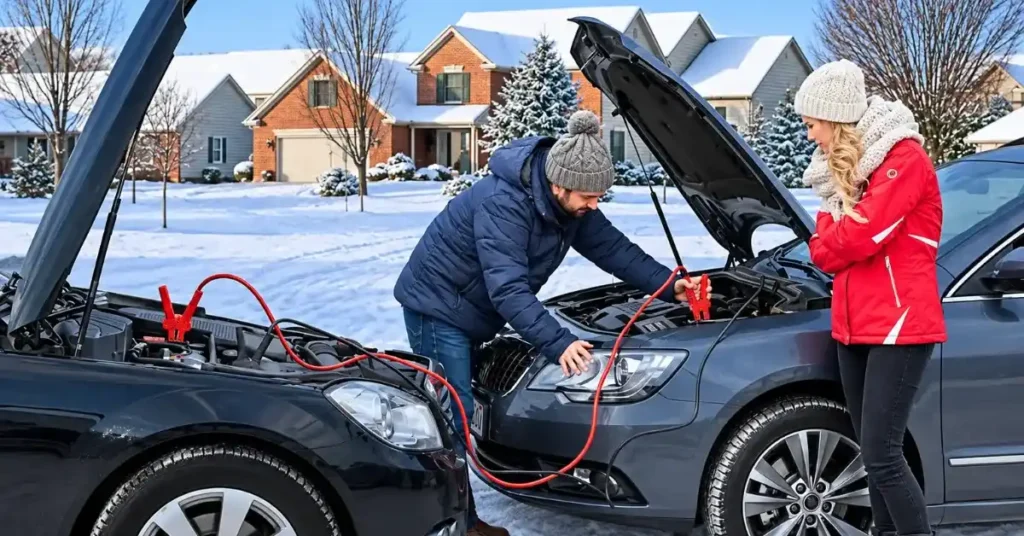
The first real cold snap of the year always brings the same scene to Ohio driveways and parking lots: someone turns the key, hears a weak groan or a click, and realizes the car is not going anywhere. Cold weather does not just make mornings uncomfortable. It changes how your battery works and how much effort your engine needs to start.
This guide explains what freezing temperatures do to a car battery, how to spot a battery that is struggling, and exactly how to jump-start a car in cold weather in five simple steps. Prefer to leave it to someone else? A jump start service sends a driver with the right gear to wherever you are stuck.
Why Freezing Temperatures Drain Car Batteries
A standard car battery makes electricity through a chemical reaction between lead plates and an acid solution called electrolyte. That reaction slows down as the temperature drops. The colder it gets, the less power the battery can deliver at the moment you need it most.
At the same time, your engine becomes harder to turn over. Motor oil thickens in the cold, so the starter has to push against more resistance. In other words, winter asks your battery for more power while giving it less ability to supply it.
How Much Power a Battery Loses in the Cold
At around 32°F, a typical battery delivers only about two-thirds of the power it can produce on a mild day. Near 0°F, available power can fall to less than half. Meanwhile, a cold engine may need up to twice as much current to start. That gap is why a battery that seemed fine in October can strand you on the first frigid January morning.
Cold Cranking Amps and Why They Matter
Every battery has a cold cranking amps (CCA) rating printed on its label. This number shows how much current the battery can deliver at 0°F for 30 seconds. A higher CCA rating gives you more starting power in winter. When replacing a battery in Ohio, choosing one that meets or exceeds your vehicle’s recommended CCA is a smart move.
Can a Car Battery Freeze?
Yes, but usually only when it is weak. A fully charged battery can handle extremely low temperatures, but a drained one can freeze at temperatures not far below 32°F, because its electrolyte contains more water. A frozen battery may have a bulging or cracked case. Never try to jump a frozen battery, since it can leak acid or even burst. Let it thaw and have it tested or replaced instead.
Signs Your Battery Is Struggling in Ohio Winters
Cold weather tends to expose a weak battery before it fails completely. Pay attention to these clues on chilly mornings:
The engine cranks slowly and sounds sluggish before starting. A rapid clicking noise replaces the normal start. Headlights or dashboard lights look dim, especially at startup. The battery warning light appears on the dash. The car needed a jump recently and is struggling again.
If you notice any of these, have the battery load tested before the next cold front rolls in. A quick test can tell you whether it simply needs a charge or is nearing the end of its life. Our battery assistance team can check a weak battery and help you decide the next step.
What You Need Before You Jump-Start a Car
Before you jump-start a car in cold weather, gather a few essentials:
A set of jumper cables, ideally heavy gauge (4 to 6 gauge) and at least 12 feet long. A second vehicle with a healthy battery of the same voltage, or a charged portable jump starter. Gloves and safety glasses, since batteries contain acid and can release gas. A flashlight for early mornings or late evenings, when daylight is short in winter.
Check your owner’s manual too. Some vehicles, including many hybrids and newer models, have specific jump points under the hood or in the trunk that should be used instead of the battery itself.
How to Jump-Start a Car in 5 Steps
Follow these five steps in order whenever you need to jump-start a car in cold weather. Connecting the cables in the right sequence protects you, both cars, and their electronics.
Step 1: Position Both Vehicles and Turn Everything Off
Park the working vehicle close to the car with the dead battery, either nose to nose or side by side, but do not let the two cars touch. Put both in park (or neutral for a manual), set the parking brakes, and turn off both engines. Switch off headlights, the radio, heated seats, and other accessories. Then pop both hoods and locate the batteries or jump points.
In winter, take a moment to brush away snow or frost around the battery. If the terminals have white or green crust, wipe them with a dry cloth or wire brush so the clamps can make solid contact.
Step 2: Connect the Red (Positive) Cable
Find the positive terminal on each battery. It is marked with a plus sign (+) and often has a red cover. Attach one red clamp to the positive terminal of the dead battery. Then attach the other red clamp to the positive terminal of the good battery. Make sure the clamps grip firmly and do not touch any other metal.
Step 3: Connect the Black (Negative) Cable
Attach one black clamp to the negative terminal (−) of the good battery. Attach the final black clamp to an unpainted metal surface on the stalled car’s engine block or frame, a few feet away from the battery. This ground point reduces the chance of a spark near the battery, where hydrogen gas can collect.
Step 4: Start the Working Car, Then the Dead One
Start the engine of the working vehicle and let it run. In mild weather, two or three minutes is usually enough. In freezing temperatures, let it run for five minutes or more so the weak battery can soak up some charge before you ask it to crank a cold engine.
Next, try starting the car with the dead battery. If it does not start, wait a few more minutes and try again. Avoid cranking for more than 10 seconds at a time. No luck after three or four tries? Stop there. The battery, starter, or alternator may need a mechanic’s attention.
Step 5: Remove the Cables and Keep the Engine Running
Once the car starts, remove the cables in the exact reverse order: the black clamp from the engine block, the black clamp from the good battery, the red clamp from the good battery, and finally the red clamp from the formerly dead battery. Keep the clamps from touching each other while any are still connected.
Leave the revived car running, then drive it for at least 30 minutes, ideally on the highway, so the alternator can recharge the battery. A short trip around the block will not put back enough power, especially in winter.
Using a Portable Jump Starter in Winter
A portable jump starter lets you jump-start a car in cold weather without waiting for another driver. The connection order is similar: red clamp to the positive terminal, black clamp to bare metal or the negative terminal, then switch the unit on and start the car.
Keep in mind that these packs also lose power in the cold. Store yours indoors when possible, recharge it every few months, and bring it inside after use. A dead jump pack in a frozen trunk will not help you.
Safety Tips to Remember
Jumping a car is simple, but a few mistakes can cause damage or injury. Keep these points in mind every time you jump-start a car in cold weather:
Never connect the red and black clamps to each other or let them touch. Do not lean directly over the battery while connecting cables. Skip the jump if the battery is cracked, leaking, swollen, or smells like rotten eggs. Avoid smoking or open flames near the battery. Keep cables away from fans, belts, and other moving parts once an engine is running.
How to Prevent a Dead Battery During Ohio Winters
A little preparation can save you from needing a jump at all. Have your battery tested in the fall, especially if it is three or more years old. Keep terminals clean and tight. Keep the car garaged overnight if possible, since even a few degrees of extra warmth helps. Combine short errands into longer drives so the battery has time to recharge. If a car will sit for long stretches, a battery maintainer can keep it topped up.
It also helps to keep jumper cables or a charged jump pack in your car all winter, along with gloves and a flashlight.
When to Call for Help Instead
There are times when it is safer to let someone else handle the jump. If you are stalled in traffic or on a highway shoulder, if it is dark and freezing, if no other vehicle is around, or if the car keeps dying after you jump-start a car in cold weather, calling for help is the better choice. A trained driver can test the battery, try a jump using proper gear, and haul the vehicle to a garage if needed. Our roadside assistance service covers jump starts, lockouts, flat tires, and fuel delivery throughout the Columbus area.
Frequently Asked Questions
Why does my car battery die more often in winter?
Cold temperatures slow the chemical reaction inside the battery, reducing its power. At the same time, cold engine oil makes the engine harder to crank, so a weak battery often fails on the first freezing morning.
How long should I let the other car run before trying to start mine?
In mild weather, two or three minutes is usually enough. In freezing temperatures, let the working car run for at least five minutes to give the dead battery more charge.
Is it safe to jump-start a car in the snow or rain?
It can be, as long as the cables are in good shape and you keep clamps clean and dry. Wear gloves, brush snow away from the battery, and never jump a battery that is cracked or frozen.
Where do I connect the last black clamp?
Attach it to an unpainted metal surface on the dead car’s engine block or frame, away from the battery. This lowers the risk of a spark near the battery.
How long should I drive after a jump-start?
Drive for at least 30 minutes, preferably at highway speeds, so the alternator can recharge the battery. Short trips may not restore enough power.
Why won’t my car start even after a jump?
Stop after three or four attempts. The battery may be too far gone, or the starter or alternator may have a problem. Call for help to have it tested or towed.
Need a Jump in the Cold? Call Burm’s Towing
When the temperature drops and you cannot jump-start a car in cold weather on your own, there is no need to stand outside figuring it out alone. Burm’s Towing helps Columbus-area drivers with battery boosts, battery help, and towing, day or night.
Call (614) 290-8512 any hour for winter battery help or 24/7 emergency towing when a jump is not enough.